latex style files
author
latex
LaTeX is a set of macros for TeX.
games
- The style sgamex.sty formats a strategic game, putting the appropriate boxes around the payoffs. For example, the input
produces the output\begin{game}{2}{2} & $L$ & $M$\\ $T$ & $2,10$ & $2,0$\\ $B$ & $3,0$ & $0,9$ \end{game}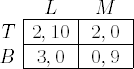
Note that (a) the payoffs are in boxes, (b) the payoff columns are of equal width, and (c) the payoffs are vertically centered within the boxes. The style is documented in sgamex.pdf.
An earlier version of the style, sgame.sty, is incompatible with
array.styand has various other limitations. The variant sgamevar.sty removes some of the limitations at the cost of a slightly less convenient syntax. The style sgamex.sty removes all the limitations while retaining the most convenient syntax, so there is no reason to use the older styles. - The style egameps.sty formats an extensive game; it is intended to handle any extensive game with relative ease. It uses the PSTricks interface with PostScript and is documented in egameps.pdf. Additional examples are given in egameExamples1.pdf, egameExamples2.pdf, and egameExamples3.pdf (due to Fioravante Patrone; the source file is egameExamples3.tex).
figures
The style pst-rputover (written jointly with Thomas Söll) defines macros that allow you to place text in PSTricks figures over graphical objects without obscuring background colors. The manual elucidates.
exams
The style UOFTEXAM.STY puts an exam in the official style of the Faculty of Arts and Science at the University of Toronto. (It puts the page footers in the right format, puts the number of questions and number of pages in the exam on the front page, puts the right statement at the end of the exam, and optionally constructs a table for the cover page of the exam that lists the questions, the number of points each is worth, and leaves space for a grader to enter the number of points a student obtains. Solutions can be included in the file and optionally included in the output.) To modify it to fit the format required by another university should be relatively easy. The style is documented in uoftexam.pdf. UOFTEXX1.TEX, UOFTEXX2.TEX, and UOFTEXX3.TEX are three examples.
articles
The following styles are for formatting academic articles.
- MJOARTI.STY: My article style. (Nothing special.)
- AER.STY: Puts an article in a style close to that of papers in the American Economic Review.
- CJE.STY: Puts an article in a style close to that of papers in the Canadian Journal of Economics.
bugs
If you find bugs in any of these styles or would like me to add new features, please let me know.